
English
Views: 25 Author: lk pharma machinery Publish Time: 2026-08-18 Origin: lk pharma machinery


Purpose
To establish a standardized procedure for the commissioning, parameter adjustment, and process control of a high-efficiency film coating machine, ensuring batch-to-batch uniformity, product quality, and compliance with cGMP standards.
Scope
Applicable to all film coating operations using aqueous or organic solvent-based coating systems. This guide is derived from actual production data and validated through real-time process monitoring.
Before loading tablet cores, perform the following mandatory checks to ensure system integrity:
| Check Item | Requirement / Action |
|---|---|
| Equipment cleanliness | Coating pan, spray guns, peristaltic tubing, and air filters must be clean and dry. No residual coating material from previous batch. |
| Compressed air supply | Stable pressure at 0.4–0.6 MPa. Check for oil/water contamination using a dry filter or indicator paper. |
| Coating suspension | Prepared according to batch formula, continuously stirred in the supply tank, and completely degassed (bubble-free) to avoid spray interruption. |
| Interlocks & sensors | Verify that door interlock, temperature probes, and pressure sensors are functioning correctly. |
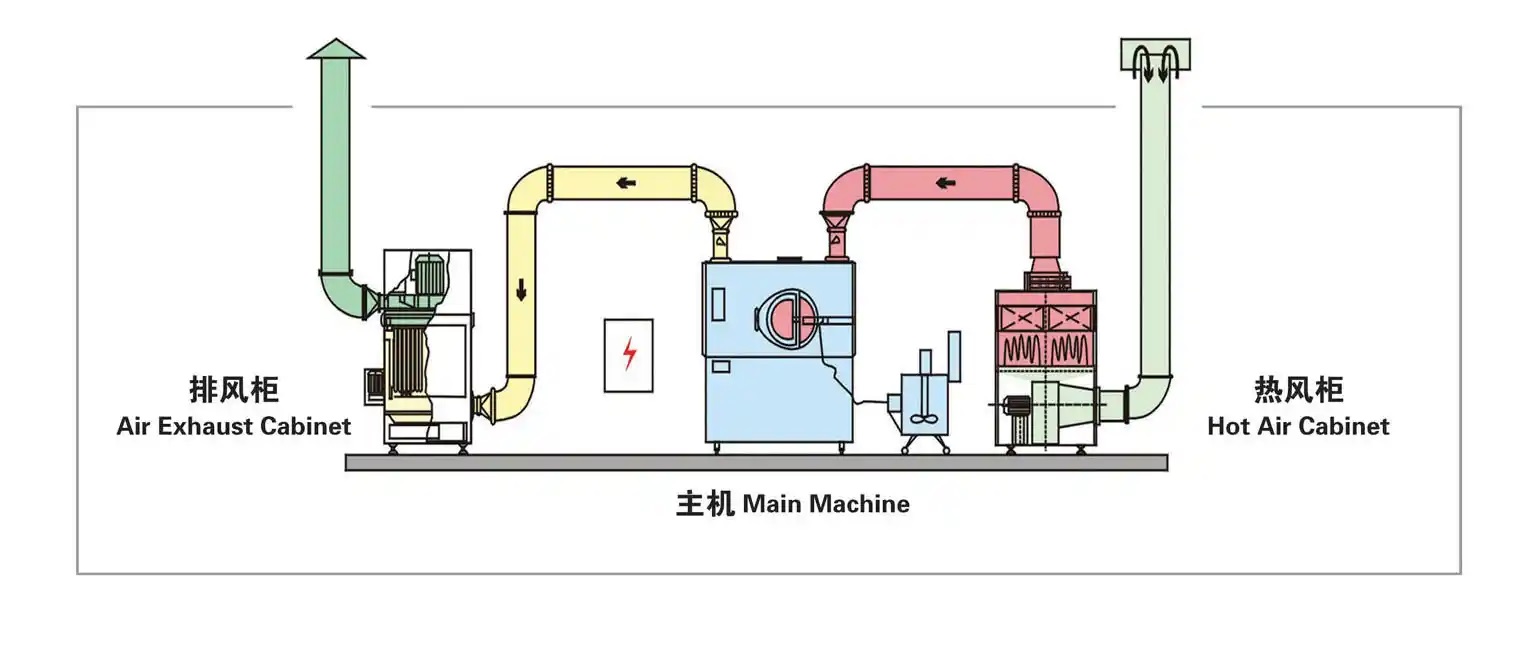
This step is critical to achieve thermal equilibrium and prevent thermal shock to the tablet cores.
Empty pan preheating
Start the system with inlet air temperature set to 50 °C, exhaust fan ON, and pan rotation at 2 RPM. Run until outlet air temperature stabilizes (approx. 10–15 min).
Load tablet cores
Introduce the tablet cores into the pan. Continue rotating at low speed (2 RPM) with heated air ON.
Core preheating target
Monitor core temperature using an infrared thermometer. The target is 30–35 °C (or as per batch record).
Rationale: Proper preheating reduces the risk of moisture penetration into the core and ensures good initial film adhesion.
Priming the liquid delivery line
Close atomizing air.
Turn on spray guns and peristaltic pump.
Purge the tubing until all air is expelled and a steady liquid stream appears. Collect purge liquid in a waste container.
Critical step: This prevents “air-lock” during the actual coating phase, which can cause intermittent spraying and uneven film formation.
Coating quality is governed by the dynamic equilibrium among spray rate, inlet temperature, and pan speed. The table below summarizes key parameters, their typical ranges, and control logic.
| Parameter | Typical Value / Range (from validation) | Purpose & Control Strategy |
|---|---|---|
| Inlet air temperature | 49–54 °C | Primary heat source. Adjust based on solvent type and core sensitivity. Water-based systems require higher inlet temp due to evaporative cooling. |
| Outlet air temperature | ~38 °C | Indicates drying efficiency. A large ΔT (inlet – outlet) means active evaporation; a small ΔT suggests over-drying or low spray rate. |
| Tablet bed temperature | 30–35 °C (critical control point) | Must be 10–20 °C above the Minimum Film-Forming Temperature (MFT) of the polymer, but below the melting/softening point of the API/excipients. |
| Pan negative pressure | –0.03 to –0.05 MPa | Maintains consistent airflow path, prevents dust escape, and ensures proper droplet contact with the bed. |
| Peristaltic pump speed | 27–34 RPM (equiv. 86–110 mL/min) | Determines coating liquid delivery rate. Increase to cool bed (evaporative effect); decrease to raise bed temperature. |
| Atomizing air pressure | Gun 1: 0.26 MPa; Gun 2: 0.16 MPa | Controls droplet size. Too low → coarse spray, poor uniformity. Too high → “dry mist” (over-atomization) and powder loss. |
| Needle / opening air pressure | 0.5 MPa | Must exceed atomizing pressure to ensure positive gun shut-off and prevent drooling. |
| Pan rotation speed | ~2 RPM (1 Hz) | Provides adequate mixing and surface exposure without excessive friability. |
| Gun-to-bed distance | ~25 cm | Balances droplet drying time. Too close → over-wetting; too far → premature drying (dry spray). |
The recorded trial data demonstrate a typical adjustment cycle. Below is the underlying logic:
When tablet bed temperature rises (e.g., >34 °C):
→ Increase peristaltic pump speed (higher liquid flow).
→ Increased solvent evaporation cools the bed.
→ Monitor temperature drop and stabilize at target (~31 °C).
When tablet bed temperature drops (e.g., <30 °C):
→ Decrease pump speed or increase inlet air temperature.
→ Reduce evaporative cooling effect to allow the bed to warm up.
Heating cycle control (recorded as 50 s cycle, 15 s ON):
This indicates a PID-based temperature controller. The “ON” time is the actual heating duration within each cycle. Adjust the PID setpoint if the bed temperature deviates consistently.
| Indicator | Action if Out of Range |
|---|---|
| Tablet bed temperature deviation > ±2 °C | Adjust pump speed or inlet air temp incrementally (±1–2 °C per step). Avoid large swings. |
| Negative pressure fluctuation | Check exhaust filter, damper position, and pan seal. |
| Outlet temperature dropping rapidly | Suggest over-wetting – reduce spray rate immediately. |
| Non-uniform spray pattern | Inspect nozzle tip for blockage; clean using solvent and compressed air. |
| Excessive dust/overspray | Reduce atomizing pressure or increase gun-to-bed distance. |
| Defect | Most Likely Causes | Corrective Actions |
|---|---|---|
| Tablet sticking / picking | Over-wetting; bed too cold; insufficient drying | Reduce pump speed; increase inlet air temp; check exhaust airflow. |
| Rough / orange-peel film | Premature drying (dry spray); high atomizing pressure | Lower inlet temp; reduce atomizing air; increase pump speed slightly. |
| Color variation between tablets | Inconsistent spray rate; poor mixing; gun position offset | Check pump tubing and rollers; adjust pan speed; re-align spray guns. |
| Capping / chipping | Core friability; excessive pan speed; over-drying | Reduce pan RPM; increase spray rate to soften drying; review core formulation. |
| Spray gun drooling / leaking | Opening pressure too low or nozzle O-ring worn | Increase needle air pressure; replace worn seals. |
Stop liquid feed first (turn off peristaltic pump), but keep atomizing air ON for 2–3 seconds to purge residual liquid from nozzle tip.
Turn off air supply and heating system.
Continue rotating pan with exhaust fan ON until tablet bed temperature drops to <40 °C to prevent moisture condensation.
Unload coated tablets and perform in-process quality checks (weight gain, appearance, thickness).
Clean all liquid lines, spray guns, and pan interior with appropriate solvents and purified water.
Document all process parameters, deviations, and corrective actions in the batch record.
Always adjust one parameter at a time, and allow the system to stabilize (3–5 min) before reading the next temperature.
Bed temperature is the single most important real-time variable – treat it as the “patient vital sign” of the coating process.
Record all data (inlet/outlet/bed temp, pressure, pump speed, air pressures) every 10–15 minutes during the run.
Calibrate temperature probes and pressure gauges at defined intervals per site SOP.
Ensure all operators are trained on the interaction between parameters – not just on reading values.


